

let's talk

From AI sprawl to governance: how IT regains a grip on agents, automation, and AI
A proliferation of disconnected AI apps and an IT team constantly putting out fires? This scenario has become all too familiar for IT management in almost every organization. But don't panic—The Flow has come up with a solution: the Efficiency Factory. Read on to find out more.
Shadow AI. On one hand, you see companies experimenting with AI at a rapid pace. An enthusiastic engineer or marketer can build their own application in no time using 'vibe coding.' Before you know it, business-critical processes are running on a personal cloud account.
On the other hand, there is the IT team. IT wants to foster innovation and make the organization agile, but within a controlled and secure framework. After all, what happens when that enthusiastic engineer or marketer leaves the company? Who monitors what sensitive company data is leaking out? And who keeps license and token costs under control when twenty different departments start purchasing tools independently?
Microsoft's answer: Agent 365 and Identity for Agents
Fortunately, technology is not standing still. With the arrival of Microsoft Agent 365 and Copilot Studio, IT finally has the necessary tools to regain governance over all those fragmented initiatives.
Within the Microsoft ecosystem, AI agents and automations are no longer viewed as isolated scripts or ad-hoc chatbots, but as full-fledged digital entities within your IT infrastructure. An agent is given its own 'persona,' a defined role, and its own identity, complete with corresponding governance, security, and monitoring.
Thanks to the advanced governance and security architecture within the Microsoft ecosystem, IT gains crystal-clear insight into:
Shadow AI and uncovering unmanaged apps: you get exact visibility into which URLs, prompts, and applications are being used across the organization. For example, you can discover how many gigabytes of data are flowing out of the company unnoticed every month.
Data guardrails and security: you determine which data sources can be accessed, who has access, and which connectors are enabled or disabled.
Cost and license management: you gain transparent control over token consumption, the licensing structure, and the technical health of all active applications.
This means you no longer have to slow down innovation or issue blanket bans. You set clear guidelines (guardrails): the business gets all the room it needs to build, while IT maintains tight control.
Why classic IT projects and isolated pilots fail
Now that you have insight into everything that's happening via tools like Agent 365, you run into the next challenge: how do you process that constant stream of requests and ideas?
Many IT organizations try to solve this the traditional way: every idea becomes a separate IT project, or they launch random pilots. But when employees start coming up with new requests faster and faster thanks to AI and low-code, the IT backlog gets completely jammed in no time. Good ideas sit on the shelf for months, employees get discouraged and drop out, and they revert to Shadow IT (AI?).
The problem, therefore, is not the idea or the technology, but the lack of streamlined coordination.
"When the demand for digital process improvement and automation flows continuously, the processing of it must do the same."
Enter: the Efficiency Factory
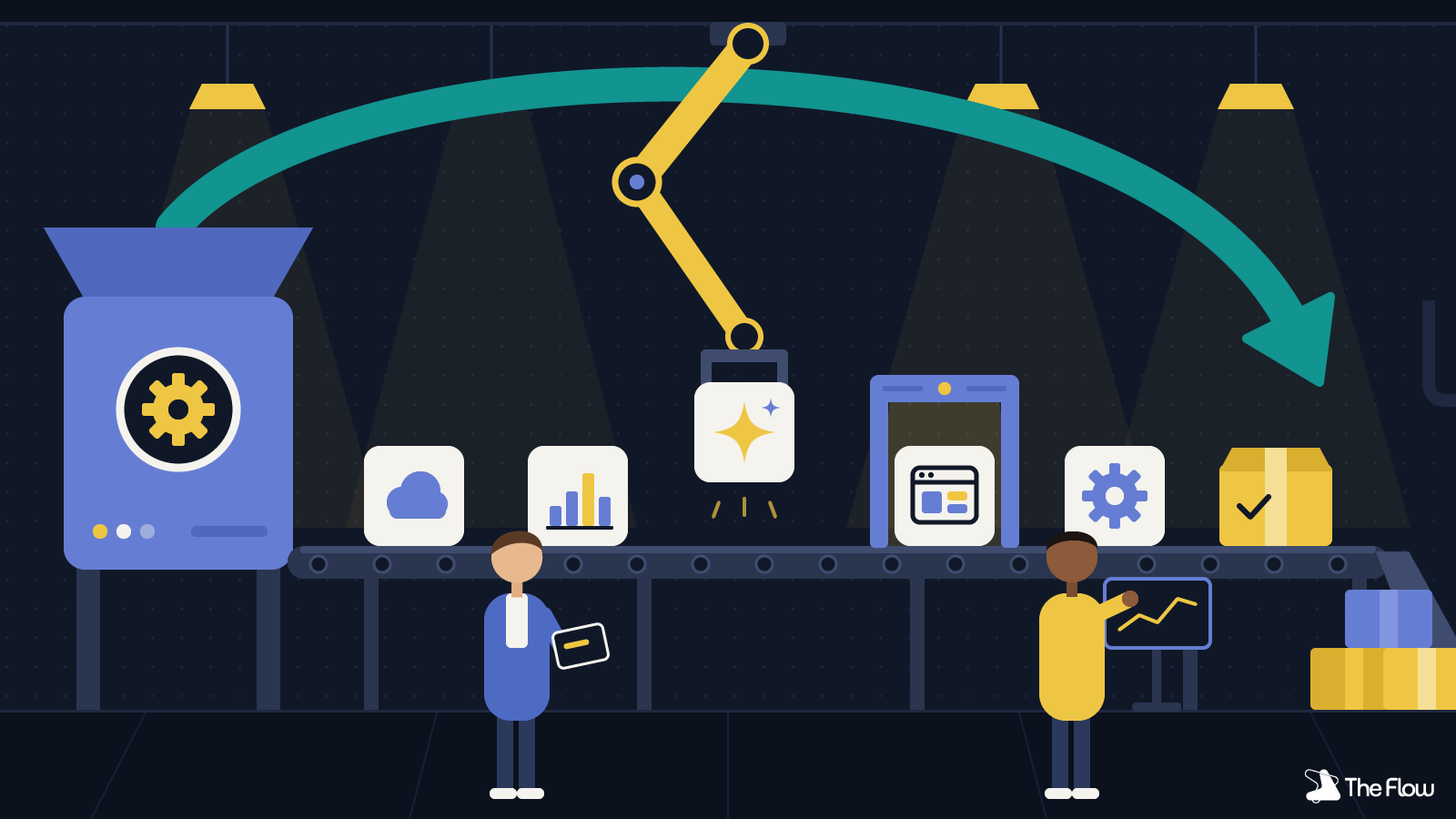
To process that continuous stream of ideas in a controlled way, you need a structure that scales with demand. At The Flow, we call this the Efficiency Factory.
The Efficiency Factory serves as the central operating model for streamlining, strengthening, and scaling all digital process improvements within your Microsoft landscape. Whether it involves smart AI agents in Copilot Studio, automated workflows in Power Automate, or custom applications in Power Apps: the Efficiency Factory acts as the central hub that transforms raw business requests into secure, managed, and scalable solutions.
The 4 building blocks of the Efficiency Factory:
- Discover: all ideas and needs enter through a single central funnel. Every proposal is evaluated for business value, feasibility, and risk before IT allocates capacity.
- Validate: not every request requires a heavy IT project. Simple workplace automations remain with the employee (using the right Power Platform guardrails), while complex, cross-departmental applications are built by a dedicated pro-dev team.
- Scale: building according to strict Microsoft architectural guidelines, clear ALM standards, and automated quality checks, combined with active user training and adoption.
- Reinforce: once an application or agent is live, we monitor performance, security, and license costs. Anything that is outdated or no longer provides value is immediately adjusted or properly decommissioned.
What does this mean in practice?
Suppose IT notices via Microsoft Purview that a team is intensively exchanging documents and data using an unmanaged online tool. In a traditional IT environment, access would simply be blocked. In an organization with an Efficiency Factory, the opposite happens: IT recognizes the need and builds a secure, automated solution in Microsoft Copilot Studio and Power Automate. Naturally, this is done in consultation with the team that will be using it. This is how you turn uncontrolled shadow IT into a secure and efficient IT solution.
Take back control of your digital landscape
Automation, low-code, and AI agents are going to change the daily work in your organization regardless. It’s not a question of if, but when. The only question that remains is: will you let it happen in a fragmented way, in the shadows, or will you, as an IT organization, deploy the Efficiency Factory to lead this transformation in a streamlined manner?
Old Situation (sprawl & Shadow IT/AI)
- Fragmented initiatives on individual accounts
- Unclear ownership and risks of data breaches
- Stalled pilots and exploding IT backlogs
With the Efficiency Factory
- One central intake for apps, flows, and AI agents
- Strict Microsoft governance and security guardrails
- A repeatable delivery engine with clear Landing Zones
Curious about how to create the right framework within your IT architecture and set up an Efficiency Factory based on the Microsoft ecosystem? Schedule a no-obligation conversation with the experts at The Flow and discover how we help your IT organization scale.

stories
More success stories



Billing information
The Flow NV
Veldkant 33A, 2550 Kontich
BE 0676.562.330